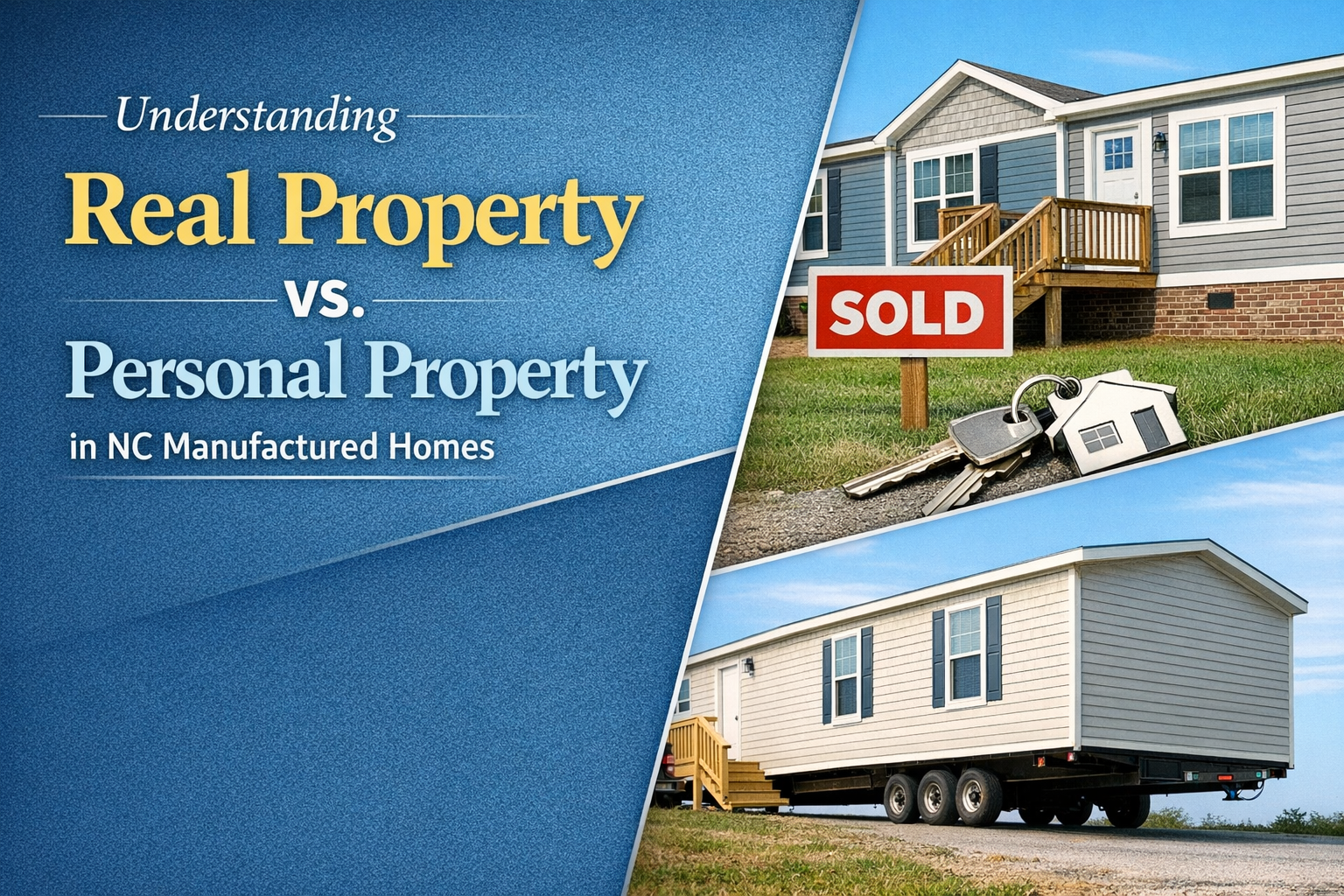
Understanding Real Property vs. Personal Property in North Carolina Manufactured Homes
If you’re investing in manufactured homes in North Carolina—whether you’re building spec homes, flipping, or lending—one concept will shape almost every deal you do:
Is the home treated as real property or personal property?
This distinction isn’t just legal theory. It directly impacts financing, titling, taxes, and resale value. Getting it right—and structuring your deals accordingly—is a major competitive advantage.
The Core Difference
Personal Property (Chattel)
A manufactured home is considered personal property when it is treated like a vehicle or movable asset.
Key characteristics:
Has a title issued through the NC DMV
Not legally attached to land
Can be moved
Financed with chattel loans (higher rates, shorter terms)
Taxed separately from land (often as personal property)
Real Property
A manufactured home becomes real property when it is legally and permanently attached to land and meets state requirements.
Key characteristics:
No active DMV title (title is cancelled)
Affixed to land with proper documentation
Treated like a site-built home
Eligible for traditional or private real estate financing
Taxed together with the land as real estate
Why This Matters for Investors
If you’re operating in North Carolina—even at a small scale—this distinction affects four critical areas:
- Financing
Personal property loans
Higher interest rates
Shorter terms
Limited lender pool
Real property loans
Lower rates
Longer terms
Access to banks, credit unions, and private lenders
For your business model—especially spec builds—real property is where the value unlock happens.
- Appraisal and ARV
Personal property homes are harder to comp and often undervalued
Real property homes can be comped alongside other residential sales
This directly impacts:
Your after-repair value (ARV)
Your ability to refinance or exit
Your lending spreads and risk tolerance
- Marketability
Buyers—and their lenders—strongly prefer real property.
A home that is:
Affixed
De-titled
Properly recorded
…will sell faster and to a broader pool of buyers than one that is still titled through the DMV.
- Lending Strategy (Critical for Mobile Home Money)
If you’re lending on manufactured homes in NC:
Personal property = higher risk
Real property = securable, recordable collateral
That’s why many disciplined lenders:
Only lend on real property
Or require conversion before final draws
Or structure the loan to force the transition during the project
How a Manufactured Home Becomes Real Property in NC
North Carolina has a clear path to convert a manufactured home from personal property to real property.
Step 1: Own the Land (or have proper interest)
The home must be placed on land owned by the borrower (or properly secured long-term interest).
Step 2: Permanent Foundation
The home must be:
Set on a permanent foundation
Connected to utilities
Installed according to state/local requirements
Step 3: File the Declaration of Intent to Affix
This is a key document under North Carolina law.
Filed at the county Register of Deeds
Declares that the home is permanently part of the real estate
Step 4: Cancel the DMV Title
Using forms such as:
Affidavit for title cancellation (e.g., MVR-46G when applicable)
Once completed:
The title is retired
The home is no longer treated as a vehicle
Step 5: Record with the Land
After these steps:
The home becomes legally part of the real estate
It is conveyed with the land in future sales
Common Mistakes Investors Make
- Not Controlling the Title (MCO / Title Risk)
If the Manufacturer’s Certificate of Origin (MCO) or title isn’t properly handled:
You can lose control of the asset
Conversion can be delayed or blocked
Best practice:
Have title/MCO routed through your closing attorney—not the borrower directly.
- Waiting Too Long to Convert
Delaying conversion:
Limits refinance options
Increases exit risk
Can create title issues at closing
- Assuming “Set = Real Property”
Just because a home is installed does not mean it is legally real property.
If the paperwork isn’t done:
It’s still personal property
And that can derail financing or sale
- Not Aligning Lending With Conversion
If you’re lending:
Final draws should often be tied to affixation + documentation
This protects your collateral position
Strategic Insight for NC Investors
If you zoom out, here’s the bigger picture:
Personal property is a temporary state
Real property is the end goal
The most successful operators in North Carolina:
Treat conversion as part of the core business process
Build systems around it
Align lenders, attorneys, and installers accordingly
Final Takeaway
If you’re building or financing manufactured homes in North Carolina, you’re not just managing construction—you’re managing legal transformation of the asset.
That transformation—from personal property to real property—is where:
Value increases
Risk decreases
Financing expands
Exit options improve
If you get this right consistently, you’ll have a major edge over operators who treat it as an afterthought.